 English
 Pусский




Want to find out how KUNBA packaging machines can benefit you? Contact and consult our team of experts to find out about packaging solutions tailored to your needs!
DZ-260 vs DZ-300 Single Chamber Vacuum Sealer – Differences
May 22,2026
For small restaurant owners, boutique coffee roasters, or meal prep businesses, choosing the right vacuum sealing equipment often feels like navigating a maze. You need something reliable, but not oversized. Efficient, but not underpowered.
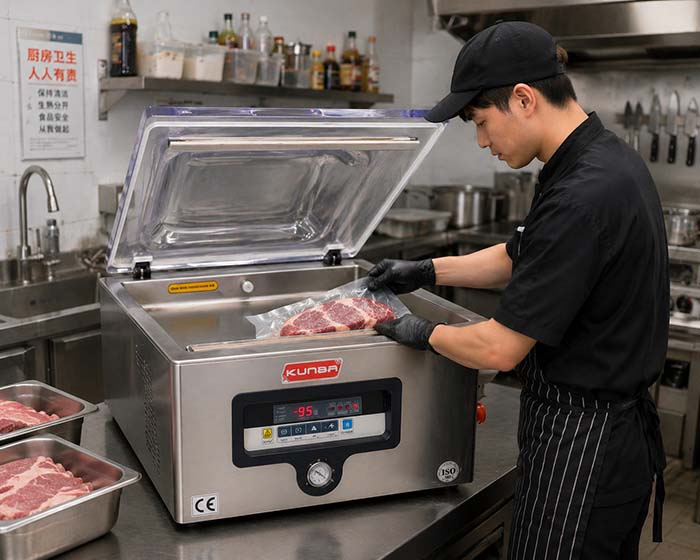
When two machines look almost identical on paper, how do you decide? The DZ-260 and DZ-300 are both single-chamber vacuum sealers from Kunba, and they share the same vacuum pump capacity, the same cycle time, and the same standard sealing width. Yet they serve slightly different users.
Let's examine what actually separates these two commercial-grade single-chamber vacuum sealers – and why one might be smarter for your specific workflow.
The Surprising Similarities
If you search for comparisons elsewhere, you will often see claims about different pump speeds or cycle times. For the actual Kunba models, those claims are incorrect.
Both the DZ-260 and the DZ-300 come with:
-
Vacuum pump capacity: 10 m³/h
-
Cycle time: 20–40 seconds
-
Sealing width: 5 mm
-
Ultimate vacuum: 0.05 hpa
-
Chamber depth: 50 mm
So why does the DZ-300 exist? The answer lies in three real-world differences that affect daily packaging.
What Actually Differs: Three Decision‑Driving Features
| Feature | DZ-260 | DZ-300 |
|---|---|---|
| Sealing length | 260 mm | 300 mm |
| Machine footprint (L×W×H) | 502×330×380 mm | 525×400×380 mm |
| sealing width | 5 mm single seal | 5 mm single seal |
Real‑World Impact of These Differences
When sealing length matters most:
If you regularly package whole chickens, large salmon fillets, or 2kg coffee bags that require a 28‑30 cm seal width, the DZ-300’s 300 mm sealing length is non‑negotiable. The DZ-260’s 260 mm limit would force you to use smaller bags or double‑seal manually.
When machine footprint matters:
The DZ-260 is noticeably more compact. For a cramped food truck, small butcher shop backroom, or pop‑up kitchen, those extra centimeters matter. The DZ-300’s larger footprint also comes with a heavier weight – more stable for high‑frequency use, but harder to move.
Which One Should You Choose?
Choose the DZ-260 if:
-
Counter space is tight
-
You process fewer than 150 bags daily
-
Your bag width never exceeds 26 cm
-
You benefit from a 5mm single seal
-
You prefer a slightly lighter machine for occasional relocation
Choose the DZ-300 if:
-
You regularly seal bags wider than 26 cm
-
You have dedicated counter space
-
You process 150–300 bags daily – the larger chamber offers better ergonomics for high volume.
-
You prefer a heavier, more stable machine that won’t shift during continuous operation.
-
Standard 5 mm seals are sufficient for your product.s
Common Misconceptions
Myth 1: “DZ-300 has a faster pump.”
No. Both use identical 10 m³/h pumps. Cycle time is the same: 20–40 seconds.
Myth 2: “DZ-300 seals more strongly because it is bigger.”Not necessarily. For demanding applications, a thicker single-layer seal can actually be more robust than the standard 5mm seal of the DZ-300.
Myth 3: “You need the larger model to handle liquids.”
False. Both have 50 mm chamber depth and handle soups, marinades, and brines equally well.
Long‑Term Value Consideration
Because the core vacuum performance is identical, your decision should be driven by bag size, available space, and seal strength requirements.
If you need to seal 30 cm wide bags, the DZ-300 is mandatory. Many businesses actually start with the entry-level chamber vacuum sealer and later add a DZ-300 for wide bags while keeping the DZ-260 for sealing products with ribs, as it performs the same as the DZ-300.
Ready to Match Your Products With the Right Seal Configuration?
Neither machine is universally “better” – they solve different packaging challenges. The DZ-260 wins on ultra‑strong seals and a small footprint. The DZ-300 wins on wide‑bag capacity and high‑volume ergonomics.
If you're unsure about the parameters your product requires, the Kumba team can help you test your actual packaging bags on two machines. We've helped hundreds of food companies avoid erroneous purchases.
Explore which commercial vacuum sealing solution fits your daily output, bag dimensions, and product sharpness. The right choice will save you both money and spoiled inventory.
Note: The images in this article are for reference only.
Latest events