 English
 Pусский





Want to find out how KUNBA packaging machines can benefit you? Contact and consult our team of experts to find out about packaging solutions tailored to your needs!
Key Specs Before Buying a Floor Type Vacuum Packing Machine | KUNBA
Jul 16,2026
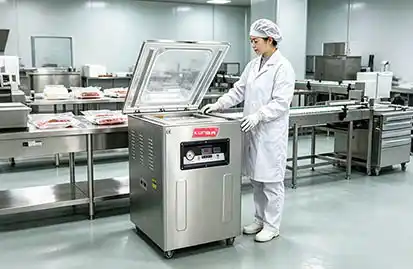
You’ve outgrown your tabletop vacuum sealer. The chamber is too small for your product batches, the cycle time is slowing down your production, and you find yourself running multiple shifts just to keep up with packaging demand. A floor type vacuum packing machine is the logical next step—but with so many specifications on the datasheet, which ones actually matter?
The truth is, not every spec is equally important for every operation. Choosing the wrong combination of chamber size, pump capacity, or sealing bar configuration can mean either overpaying for capability you don’t need or, worse, buying a machine that can’t keep up with your actual production requirements.
This guide walks through the five most critical specifications you need to evaluate before purchasing a floor standing vacuum packaging machine—and explains what each one means for your day-to-day operations.
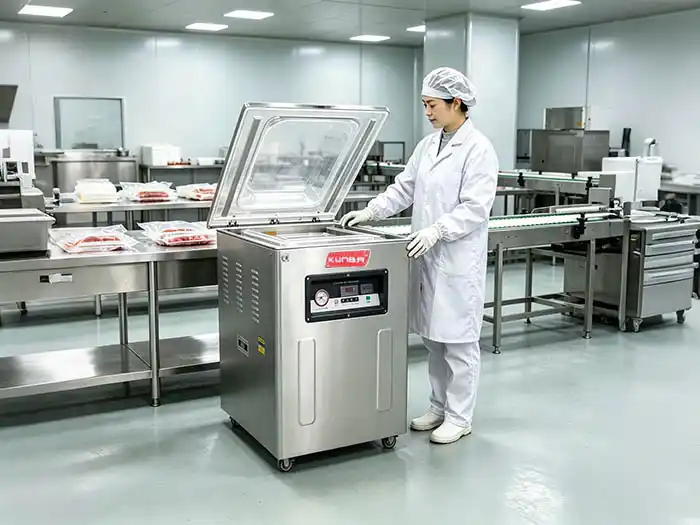
Chamber Size: The Non-Negotiable Foundation
The chamber is where the vacuum happens. If your product doesn’t fit inside the chamber, nothing else matters.
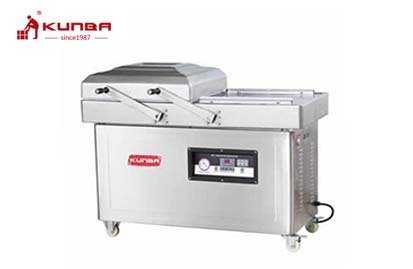
What to look for: Chamber dimensions are typically listed as length × width × height (L×W×H) in millimeters. Floor type machines offer significantly larger chambers than tabletop models—some with chamber sizes exceeding 800mm in length and 550mm in width. Double-chamber configurations are also common in floor standing models, allowing one chamber to be loaded while the other is running.
What it means for you: Chamber size determines the maximum product dimensions you can package. But there’s a common mistake: measuring only the product itself. You also need to account for:
-
Bag overhang: The bag needs room to extend beyond the sealing bar.
-
Product height: Including any trays, containers, or irregular shapes.
-
Liquid displacement: If you’re packaging liquids or semi-liquids, the chamber needs extra height to prevent boil-over during vacuum.
A practical rule: Choose a chamber that’s at least 50–100mm larger than your largest product in each dimension. This gives you room to maneuver bags and accommodates variations in product size.
Vacuum Pump Capacity: The Engine of Your Machine
The vacuum pump is the heart of any vacuum packaging machine. Its capacity directly determines how fast your machine cycles and how deep a vacuum it can achieve.
What to look for: Pump capacity is measured in cubic meters per hour (m³/h). Floor type machines typically range from 20 m³/h for lighter-duty models up to 100 m³/h or more for high-volume operations. Some double-chamber machines use two pumps or a single larger pump feeding both chambers.
What it means for you:
-
Higher pump capacity = faster cycle times. A 40 m³/h pump will evacuate the chamber faster than a 20 m³/h pump, meaning more packages per hour.
-
Faster cycles = higher throughput. If you’re packaging hundreds of units per day, the difference between a 20-second cycle and a 40-second cycle adds up to hours of lost productivity.
-
Pump type matters: Oil-lubricated rotary vane pumps are the industry standard for durability and performance. Oil-free pumps require less maintenance but may have lower capacity or shorter service life.
A practical rule: Match pump capacity to your daily volume. For 100–200 packages per day, 20 m³/h may suffice. For 500+ packages per day, look for 40 m³/h or higher. For continuous operation in food processing, pumps in the 60–100 m³/h range are common.
Sealing Bar: Length, Configuration, and Material
The sealing bar is what actually closes the bag. Its length determines the maximum bag width you can seal, and its configuration affects how efficiently you can work.
What to look for:
-
Sealing bar length: Measured in millimeters. Floor type machines offer sealing bars from 400mm up to 1,000mm or more. Longer bars accommodate wider bags.
-
Number of sealing bars: Single-bar machines seal one bag at a time. Double-bar machines allow two bags to be sealed simultaneously—or provide redundancy if one bar fails.
-
Sealing bar material: Stainless steel is preferred for hygiene and durability, especially for food applications. Teflon-coated bars prevent sticking and are easier to clean.
What it means for you:
-
Bar length determines bag compatibility. If you’re packaging large items like whole poultry, bulk meat cuts, or industrial components, you need a bar long enough to accommodate the bag width.
-
Multiple bars increase efficiency. With two sealing bars, you can seal two smaller bags in the same cycle—effectively doubling throughput for smaller items.
-
Bar configuration affects layout. Some machines have bars along the front (parallel to the operator), others along the side. Choose based on your workflow and operator positioning.
A practical rule: Measure your widest bag and add 50mm. That’s your minimum sealing bar length. If you regularly package multiple small items, consider a double-bar configuration.
Construction and Materials: Built to Last
A floor type vacuum packing machine is a significant investment. The materials and construction quality determine how long it will last—and how easy it is to keep clean.
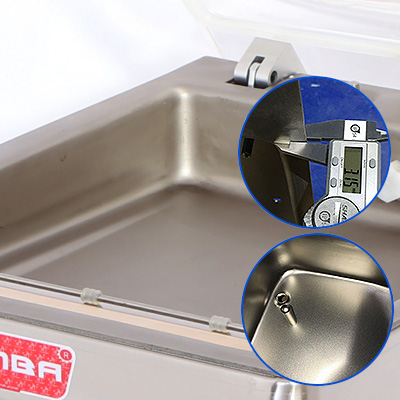
What to look for:
-
Stainless steel construction: Food-grade 304 stainless steel is the industry standard for chambers, bodies, and contact surfaces. It resists corrosion, cleans easily, and meets hygiene requirements.
-
Rounded internal corners: Chambers with rounded corners are significantly easier to clean than those with sharp angles. Food residue and liquids can’t get trapped in corners.
-
Removable sealing bars: Bars that can be easily removed for cleaning and maintenance extend component life and reduce downtime.
-
Locking casters: Floor-type machines are heavy—often 90kg or more. Locking casters allow mobility when needed and stability during operation.
What it means for you:
-
Stainless steel = sanitation + longevity. In food processing environments, non-stainless materials can rust, corrode, or harbor bacteria. 304 stainless is the minimum standard.
-
Easy cleaning = less downtime. Machines designed for quick cleaning—with accessible chambers, removable parts, and smooth surfaces—spend less time out of service.
-
Mobility = flexibility. Casters let you move the machine between workstations or store it when not in use.
A practical rule: If you’re packaging food products, insist on 304 stainless steel construction and inspect the chamber for cleanability. Rounded corners and removable seal bars are non-negotiable for hygiene-critical applications.
Control System: Digital vs. Analog
The control system determines how you interact with the machine—and how much flexibility you have for different packaging applications.
What to look for:
-
Digital control panels: Microcomputer-controlled systems with programmable parameters allow you to store settings for different bag types and products. This is essential if you package multiple products with different requirements.
-
Analog/mechanical controls: Simpler machines use dials and timers. These are reliable and easy to troubleshoot but require manual adjustment for each product change.
-
Programmable parameters: Look for machines that let you adjust vacuum time, sealing time, cooling time, and gas flush settings. The ability to save presets is a major productivity booster.
What it means for you:
-
Digital controls = consistency. Once you find the right settings for a product, you can save them and recall them instantly. This eliminates guesswork and reduces operator error.
-
Gas flush capability: If you package products that benefit from modified atmosphere packaging (e.g., fresh meat, cheese, coffee), look for machines with gas flush functionality.
-
Cycle time monitoring: Some digital systems display cycle time and vacuum level in real time, helping you troubleshoot and optimize.
A practical rule: If you package more than two different product types regularly, invest in a digital control system with programmable presets. The time saved on setup will quickly justify the additional cost.
Putting It All Together – A Decision Checklist
| Specification | What to Check | Why It Matters |
|---|---|---|
| Chamber Size | Length × Width × Height (mm) | Determines maximum product dimensions you can package |
| Pump Capacity | m³/h rating | Higher = faster cycles = higher throughput |
| Sealing Bar | Length, number of bars, material | Determines bag width compatibility and efficiency |
| Construction | 304 stainless steel, rounded corners | Affects durability, hygiene, and cleaning ease |
| Control System | Digital vs. analog, programmable presets | Impacts setup time, consistency, and flexibility |
Before you buy, ask yourself:
-
What’s my largest product—and does it fit with room to spare?
-
How many packages do I need to seal per day—and what pump capacity supports that?
-
Do I seal multiple bag sizes—and do I need programmable presets?
-
Is food-grade construction and easy cleaning a requirement for my application?
-
Do I need gas flush capability for my products?
Next Steps: From Specifications to Selection
Understanding these five key specifications gives you a clear framework for evaluating any floor type vacuum packing machine. But specifications on paper don’t tell the whole story—build quality, after-sales support, and spare parts availability matter just as much in real-world operation.
Once you’ve clarified your requirements across chamber size, pump capacity, sealing bar configuration, construction quality, and control system needs, comparing the specific models available becomes the next logical step. You can review KUNBA’s range of vacuum packaging solutions, including floor standing models designed for different production scales and applications.
For ongoing education, consider reading KUNBA’s guide on automatic vs. manual vacuum packing machine selection, which provides a framework for matching machine types to your specific production volume and labor considerations.
Related Reading
-
Automatic vs. Manual Vacuum Packing Machine: Selection Guide
-
Double Output: Upgrading to a Fully Automatic Vacuum Packing Machine
-
Why Your Vacuum Sealer Won't Seal – 3 Quick Fixes
-
How Often to Clean a Chamber Vacuum Sealer
This article is part of KUNBA’s technical content library. No direct sales or pricing information is included. All technical discussions aim to help you make informed purchasing decisions.
Latest events